
The sun has just set as we arrive at Shireen’s home and she greets us from the sheep pen, where she is in the midst of milking, and tells us to take a seat on the sheltered porch.
It’s a landscape familiar to me in the daylight, but as night falls and lights begin to come on, illuminating the illegal Israeli settlements and outposts in this part of the Jordan valley, the recognisable landmarks of Palestinian homesteads, greenhouses and sheep pens disappear into the blackness, as if they have been erased.
Shireen emerges with a bucket of fresh milk and strains it through a muslin cloth and I help her carry it inside, where she is going to teach me how to make jibneh, a traditional Palestinian cheese. We are joined by her neighbour Rana and her two daughters, Hala and Mirvat and the work begins, adding the rennet to the milk and waiting on the “clean break” that will allow for the cheese to be formed.
This is women’s work and as the men sit out on the porch, smoking and drinking coffee, it is a chance for the women to catch up. It’s a beautiful pastoral scene that could have been straight out of the rural Ireland of my grandmother’s generation.
As we being to talk, I learn that Shireen has been issued with a “stop work” order for her home and that Rana’s family have been issued with a demolition order.
In the Israeli-occupied West Bank, Palestinian communities in the Jordan Valley face two closely related administrative enforcement tools used by the Israeli authorities.
A demolition order is an administrative or military order issued by the Israeli authorities, ordering that a structure built without an Israeli‐issued permit, or located in a restricted zone, must be demolished, either by the owner or by the authorities themselves. Israeli human rights group B’Tselem reports that between January 2006 and September 2017 nearly 700 Palestinian residential units in the Jordan Valley were demolished by the Civil Administration.
A stop‐work, or stop‐construction, order is an administrative notice delivered to a Palestinian individual, family or community ordering them to halt any ongoing building, expansion or construction of structures including homes, animal pens, water or irrigation systems on the grounds that they lack an Israeli permit. Though not an immediate demolition, such orders place a legal threat over the structure and often precede a demolition. In the Jordan Valley context these orders are common, and many communities report repeated stop‐work notices.
Both instruments operate within a broader regime of Israeli planning and military policy in the Jordan Valley, which is aimed at restricting Palestinian presence and development in favour of Israeli settlement, military training zones and a de facto strategy of control. A 2023 academic study found that around 22 % of households in the Jordan Valley had their homes destroyed, and 12 % were under threat of demolition.
In the Jordan Valley, the usage of stop‐work orders and demolition orders is intertwined with several characteristics of the area. Many communities are small, scattered Bedouin or herding communities, many are located in so-called “firing zones” where Israeli military exercises occur, and many lack formal Israeli planning permits because nearly all land in Area C is under Israeli authority. Israeli planning authorities rarely grant permits to Palestinians, with approval rates of below 4%, so if a family builds or repairs their home or agricultural building or pen out of necessity, they risk an order being issued either to stop work or to demolish.
The school in Al Mu’arrajat that I wrote about previously had been issued with 22 demolition and stop work orders, including a prohibition on planting further trees and on painting the exterior of the building. In Shireen’s case, she was issued a stop work order after planting a vegetable garden on her own land. She now grows everything in containers lined up along her porch, but this doesn’t yield enough to last like the garden did, so she has to supplement with fruit and vegetables bought from the market. Rana’s family was issued a demolition order after they replaced a leaking roof on their home, having been refused a work permit. She now fears the bulldozers will come to tear off the roof and will demolish her home in the process.
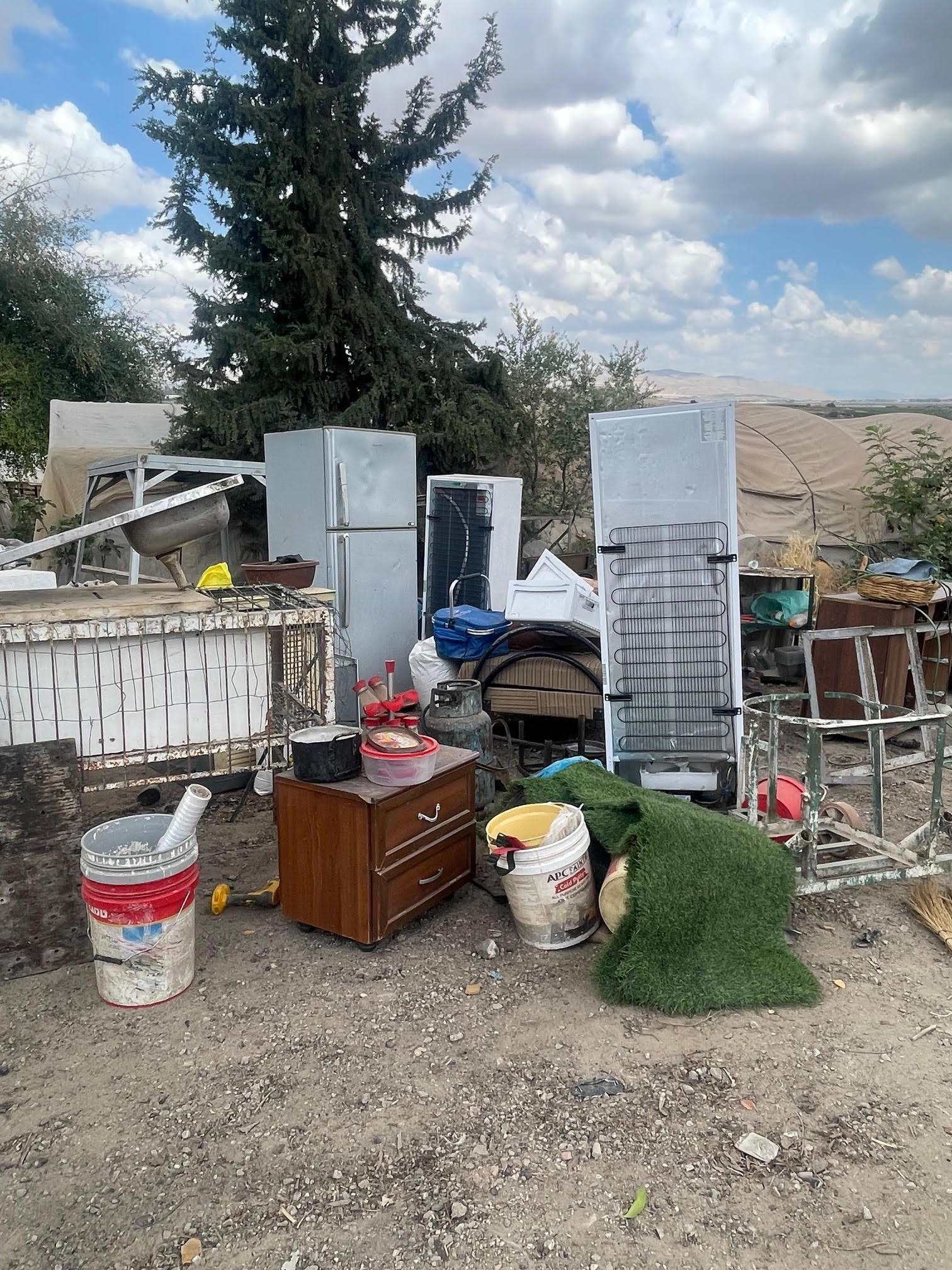
According to the Wafa news agency, 903 new demolition orders were issued in the West Bank in 2024. When demolitions happen, they are swift and brutal. We arrived at the site of one to be told that the family had been given 15 minutes to take their belongings out. We helped to ferry essential kitchen items and school books out of the path of the bulldozers into neighbouring homes. It was heart-breaking to witness.
As Shireen shows me how to portion out the jibneh, wrap it in cheesecloth and set it on an angled board to drain, she tells me of her neighbours who moved away after their home was demolished, their livelihood taken from them with the swing of a digger bucket.
“You can’t keep sheep and goats outside in the summer heat, so when the animal shelters were destroyed they had to sell the animals and move to Nablus. They don’t want to live in the city, but they had no choice,” she says.
Demolition and stop work orders impact in multiple ways, causing displacement and homelessness, disruption or removal of people’s livelihood, a life of uncertainty and living on edge and ultimately feed into Israel’s policy of annexation of the West Bank.
And yet, as the cats lap up the whey, we are five women working in gentle harmony making cheese, sharing stories and laughter. Every swirl and form of the curd is a remembrance of heritage and an act of resilience and hope. In the Jordan Valley, the continuing of tradition is the most powerful act of resistance.