
According to the Department of Education account on X this week, Paul Givan toured a number of schools in Israel to “ learn more about Israel’s innovative approaches to gifted education and inclusive learning.”
The visit in itself, funded by and in support of a Zionist regime which is actively committing genocide against children and which has repeatedly bombed schools in Gaza, is appalling. But to talk about inclusive education and Israel in the same sentence is jaw-dropping.
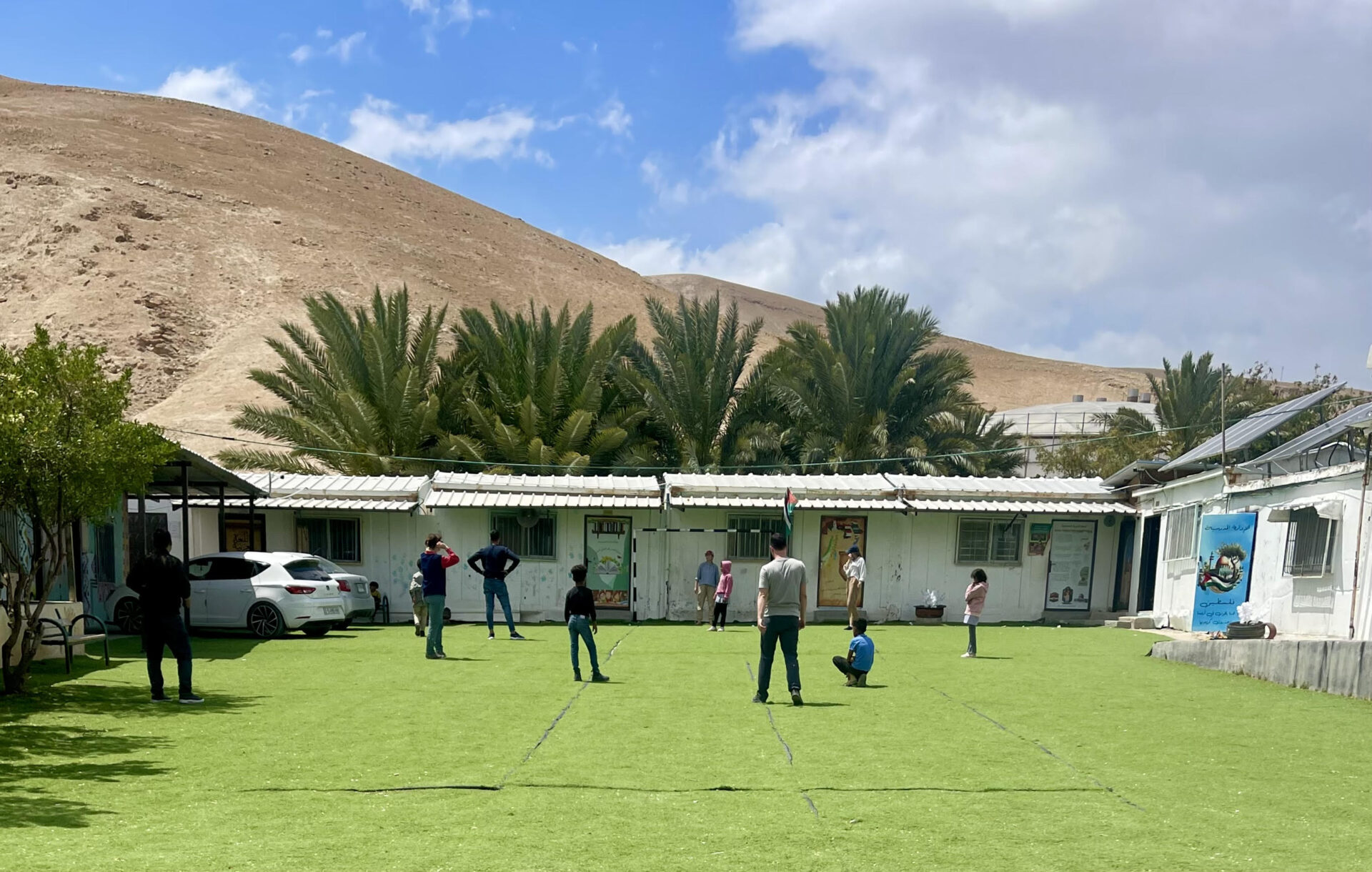
The reality for Palestinian children is that the expansion of Israeli settlements and the surge in settler violence in the occupied West Bank has deeply undermined their right to a safe, uninterrupted education.
According to the United Nations Office for the Coordination of Humanitarian Affairs (OCHA), multiple incidents in and around schools, including clashes, tear-gas exposure, and live ammunition, have resulted in hundreds of injuries to students and staff, disrupting classes and forcing detours or cancellations.
In the West Bank and East Jerusalem, dozens of schools face demolition or seizure orders because of difficulties in obtaining Israeli work permits, leaving children to study in tents or travelling long distances to try and access education. Arab al-Kaabheh School in the village of Al Mu’arrajat in the Jordan Valley is a collection of metal containers set in a U-shape around a central courtyard. It is part of a humanitarian project funded by the EU and Irish Aid, amongst others under the EU Humanitarian Support Programme to protect Palestinians in the West Bank from forcible transfer.
In September last year, Israeli settlers from the illegal Zohar outpost nearby invaded the school during class time. They assaulted teachers and students with clubs and iron bars and tied up the principal, who was subsequently hospitalised. Afterwards, they placed dolls spattered in red paint, to resemble blood, at the entrance to the school. The dolls were then used again in another attack in January to adorn mock child graves outside the school.
The US State Department has sanctioned Zohar Sabah, the Israeli settler responsible for the establishment of the illegal outpost near the school for his “role(s) in violence targeting civilians or in the destruction or dispossession of property” in the West Bank. The State Department said Sabah had “engaged in threats and acts of violence against Palestinians, including in their homes” and stated that he had participated in the attack on the school.
My team and I spent a lot of time with the pupils and staff at the school providing a protective presence to try and discourage further settler attacks when the children were present. As a result of the previous attacks, workers were too afraid to come to the school so we also did some maintenance work such as gardening and painting.
There was always time for a game of football or sitting with the children at breaktime sharing juice and cookies whilst they laughed at my terrible Arabic pronunciation and learned the odd word of Irish. Every time we were there, the familiar white pick-up belonging to the head of Settlement security would come by the school several times and a drone would fly overhead, filming. Twice the Israeli military came and searched the school whilst we were there.
Two years ago, there were 50 families living in Al Mu’arrajat but increasing settler violence saw that number dwindle to 20 by this summer. The in July, in an attack which lasted two days, the remaining families were forced from their homes by settlers with the support of the Israeli military. The school was destroyed, computers and windows broken, the artificial grass football pitch torn up, graffiti sprayed on walls and doors.
The aftermath of the attack was reported by Channel 4 news and it was heartbreaking to see the little school we had come to love, where we were welcomed on day 1 with steaming plates of Maqloubeh, destroyed and devoid of children.
The families of Al Mu’arrajat took successful legal action against the settlers who had stolen their homes and returned a few weeks later. The response of the settlers was to return will bulldozers and demolish the homes, forcing people inside to flee for their lives as roof beams and masonry fell around them.
Another Palestinian school has been destroyed, its pupils scattered to surrounding communities, living in tents or in the overcrowded homes of relatives. The classroom that should have been their safe space became the place of their nightmares.
This environment of fear, marked by random attacks on students and teachers, impeded access to classrooms, and the looming threat of school closure, inflicts a profound psychological toll on children. They suffer from anxiety, trauma, disrupted concentration and, ultimately, impaired academic performance.
The broader infrastructure of the expansion of illegal settlements such as checkpoints, diverted roads and segregated zones, similarly obstructs access to schooling and reinforces educational inequities. The cumulative effect is the erosion of not just the educational prospects of Palestinian children, but also their sense of safety, stability and vision for the future.
In Bethlehem, Israeli forces fired tear gas at children on their way to school. In the Jordan Valley, teachers are frequently detained for hours at military checkpoints, delaying lessons and depriving children of their education. The destruction of schools in several Palestinian villages is part of a broader pattern of displacement and restriction that undermines children’s right to learn. All of these acts were witnessed and reported on by our team in Palestine.
The Minister would do well to confront the realities facing Palestinian children under occupation and he should be asked to clarify how actions such as the above align with commitments to inclusivity, human rights, and the protection of children in conflict zones.